16 Interesting Facts About Bessie Coleman
When Bessie Coleman decided she wanted to fly, the world gave her two very clear answers: no, and absolutely not. She ignored both.
Bessie Coleman became the first Black woman and the first Native American woman to earn a pilot’s license. She did it by leaving the United States, learning a new language, and refusing to accept limits placed on her because of her race or gender. Her story is one of courage, determination, and choosing possibility over permission.
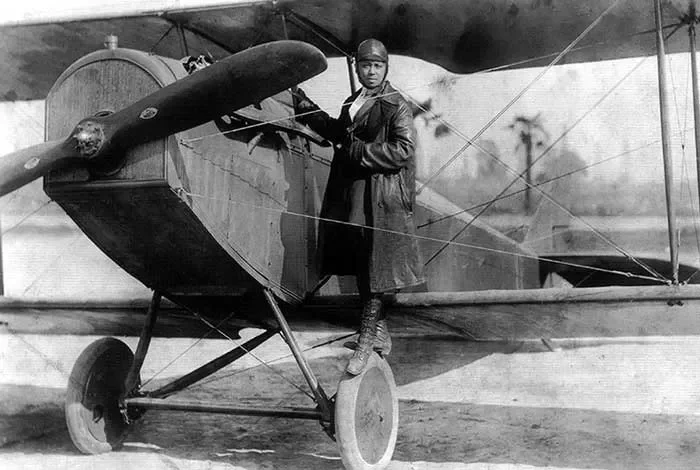
Bessie Coleman, Curtiss Field, L.I. 1922 (Cradle of Aviation Museum)
Below are 16 key facts that help tell her story in a way that’s clear, memorable, and accessible for students.
16 Facts About Bessie Coleman
1. Bessie Coleman was the first Black woman pilot.
She was also the first Native American woman to earn a pilot’s license, making her a double pioneer in aviation history.
2. She was born in Texas in 1892.
Bessie grew up in a large farming family during a time when segregation and racial violence were common in the United States.
3. Her father left Texas to escape Jim Crow laws.
He moved to Indian Territory in Oklahoma, hoping for better opportunities, but Bessie’s mother stayed in Texas with the children.
4. She valued education from a young age.
At just 18 years old, Bessie saved money to attend Langston University in Oklahoma.
5. She had to leave college due to financial hardship.
Although she could only attend one semester, her determination to keep learning never faded.
6. She moved to Chicago to find better opportunities.
Chicago offered more freedom and possibility than the South, especially for Black Americans.
7. Bessie trained as a manicurist and entrepreneur.
She attended the Burnham School of Beauty Culture, worked in a barbershop, and later opened a successful chili parlor on Chicago’s South Side.
8. Stories from her brothers inspired her dream of flying.
After returning from World War I, her brothers told her that women in France were allowed to learn how to fly airplanes.
9. U.S. flight schools refused to accept her.
Every aviation school she applied to in the United States rejected her because she was Black and a woman.
10. She learned French to pursue her dream.
Bessie studied French at the Berlitz School in Chicago so she could train overseas.
11. She earned her pilot’s license in France.
In 1921, she became a licensed pilot at the Caudron Brothers’ School of Aviation.
12. She became a famous stunt pilot.
Bessie performed daring aerial tricks and parachute jumps at air shows across the country.
13. She refused to perform at segregated events.
Bessie would not fly at shows that treated Black audiences unfairly or forced them to use separate entrances.
14. She protected her dignity and image.
She turned down a movie role because it portrayed her as poor and helpless, refusing to
reinforce stereotypes.
15. She survived a serious plane crash.
An accident broke her leg and ribs, and it took nearly two years before she was able to fly again.
16. Her legacy continues today.
After her death at age 34, Bessie Coleman was honored with Bessie Coleman Day in Chicago, aviation clubs named after her, and a U.S. Postal Service commemorative stamp.
Why Bessie Coleman Still Matters
Bessie Coleman didn’t just want to fly for herself. She dreamed of opening a flight school for African Americans so others could follow her into the skies. Although she didn’t live long enough to see that dream completed, others carried it forward in her name.
Her life reminds us that history isn’t only shaped by those who are allowed into the room. Sometimes it’s shaped by the people who build a door somewhere else.
🎥 Watch
Kids Quiz: Bessie Colemanhttps://youtu.be/wbDGFLdL9Gw
Learn More for Kids
For kid-friendly lessons, videos, and Black history resources, visit SankofaChicago.com
