10 Events in History that have used the Raised Fist Symbol
A raised fist—also known as the Power Fist—symbolizes solidarity and support. It has been used across movements fighting oppression related to gender, race, class, and ethnicity. The gesture represents unity, strength, defiance, and resistance.
Its most well-known use is by the Black Panther Party in the 1960s, where it became a powerful emblem of the Black Power movement. Over time, this symbol has represented not only racial struggles but also broader fights for equality, social justice, and human rights.
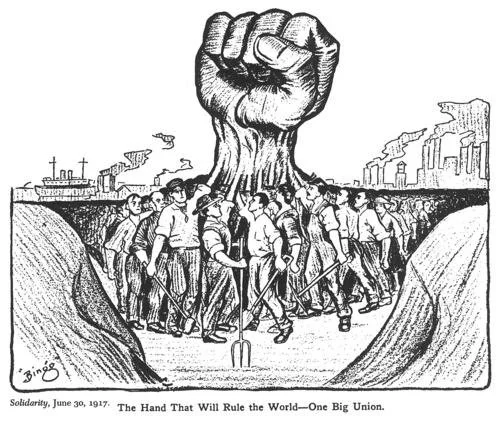
The Hand that will Rule the World
Early Origins of the Raised Fist
One of the earliest known depictions of the raised fist appeared on June 30, 1917, in the illustration “The Hand That Will Rule the World” by Ralph Chaplin, published by the Industrial Workers of the World (IWW) newspaper Solidarity. The drawing shows a crowd of workers joining their fists together to form one powerful, unified fist—symbolizing collective strength and solidarity among the working class.
Even earlier, in the mid-19th century, French artist Honoré Daumier used the raised fist in his work The Uprising (L’Émeute), inspired by the Revolution of 1848, which overthrew King Louis-Philippe’s monarchy. Daumier’s painting reflected the intense passion and determination of the Parisian people during the Bloody June Days—a symbol of their will to fight for justice.
The Fist in 20th-Century Activism
In 1917, the IWW adopted the raised fist as a logo, representing worker unity and defiance.
During the Spanish Civil War (1936–1939), Republican militias and international brigades used the gesture as an anti-fascist salute, known as the “Popular Front salute.” Photographs even show children giving the salute as they prepared for evacuation, a symbol of resistance that has been carried by all generations.
In 1948, the fist reemerged as a symbol in Mexican political art through the Taller de Gráfica Popular, a print shop that created revolutionary graphics advocating for workers’ and social rights.
The Fist in U.S. Civil Rights Movements
The raised fist took on renewed meaning in the 1960s through American activism. Artist and activist Frank Cieciorka created a graphic version for the Student Nonviolent Coordinating Committee (SNCC), which was later adopted by the Students for a Democratic Society and the broader Black Power movement.
Perhaps the most iconic moment came at the 1968 Olympics, when Black athletes Tommie Smith and John Carlos raised their fists during the medal ceremony to protest racism and injustice on the world stage. As Tommie Smith later said, “We had to be seen because we couldn’t be heard.”
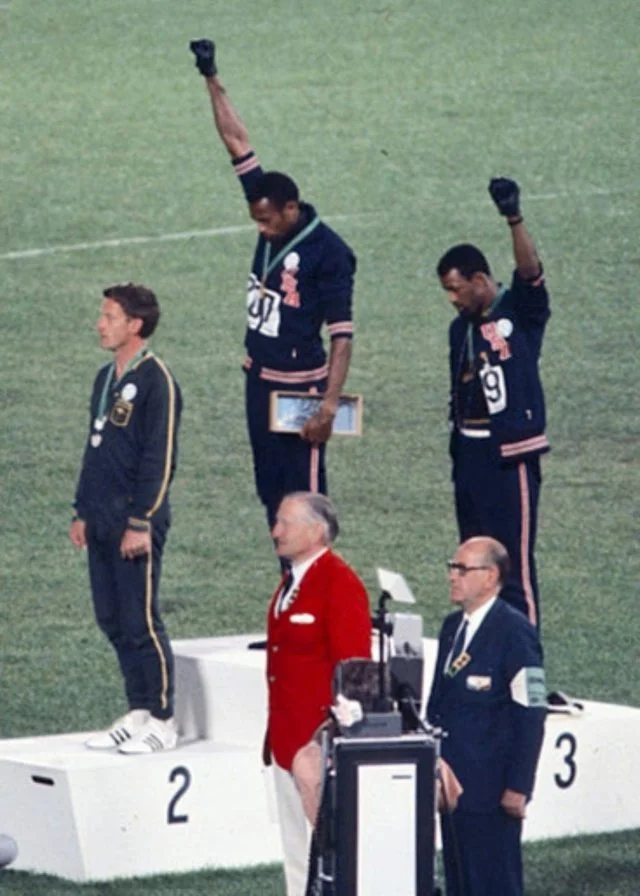
Gold medalist Tommie Smith (center) and bronze medalist John Carlos (right) showing the raised fist on the podium after the 200 m race at the 1968 Summer Olympics
Feminist and LGBTQ+ Movements
The fist continued to evolve as a universal symbol for equality. During the 1968 Miss America protest, feminists used it to reject gender oppression and objectification. It soon became the visual emblem of the women’s liberation movement.
Later, the Pride movement also incorporated the raised fist as a mark of resistance and inclusion. According to TriPride, a version of the Pride flag featuring the fist and stripes of brown and black represents queer people of color (QPOC) and solidarity among diverse identities.
The Raised Fist Today: Black Lives Matter and Beyond
In recent years, the raised fist has become synonymous with the Black Lives Matter movement, continuing its legacy as a symbol of defiance against racial injustice. From protests in Chicago to marches worldwide, this gesture remains a powerful call for equality, unity, and change.
