Ruby Bridges: The Civil Rights Icon We’re Still Not Teaching in Full
“I think the lesson that I learned is that you can’t look at a person and judge them. You have to allow yourself the opportunity to really get to know them, no matter what they look like. ”
Watch: Kid Professors explain who Ruby Bridges is and why her story matters.
Who Is Ruby Bridges?
Ruby Bridges is a civil rights activist whose role in school desegregation changed American education and continues to shape how Black history is taught today.
Most people recognize her from a photograph or a short paragraph in a textbook. But last year, my family and I saw Ruby Bridges speak at the University of Chicago, and it changed how I think about her story entirely. Sitting in that room, listening to her speak, it became clear how rare it is to witness living history. This wasn’t a symbol or a chapter heading. This was a woman whose childhood reshaped the country, standing in front of us in real time.
Seeing her in person made it impossible to reduce her story to a single moment or image ever again.
Why Her Story Matters Beyond the Textbook
On November 14, 1960, Ruby Bridges became the first Black child to integrate the all-white William Frantz Elementary School in New Orleans. She was six years old.
Each day, four federal marshals escorted her past screaming crowds. Parents pulled their children from the school. Ruby sat alone in a classroom for much of the year, taught by a single teacher who refused to abandon her.
What is often left out is the cost beyond the school doors. Ruby’s father lost his job. Her grandparents were forced off their land. Local businesses refused to serve the family. This was not a single act of bravery. It was sustained pressure placed on a child and her family for daring to exist in a space they were told was not meant for them.
And still, Ruby did not miss a single day of school.
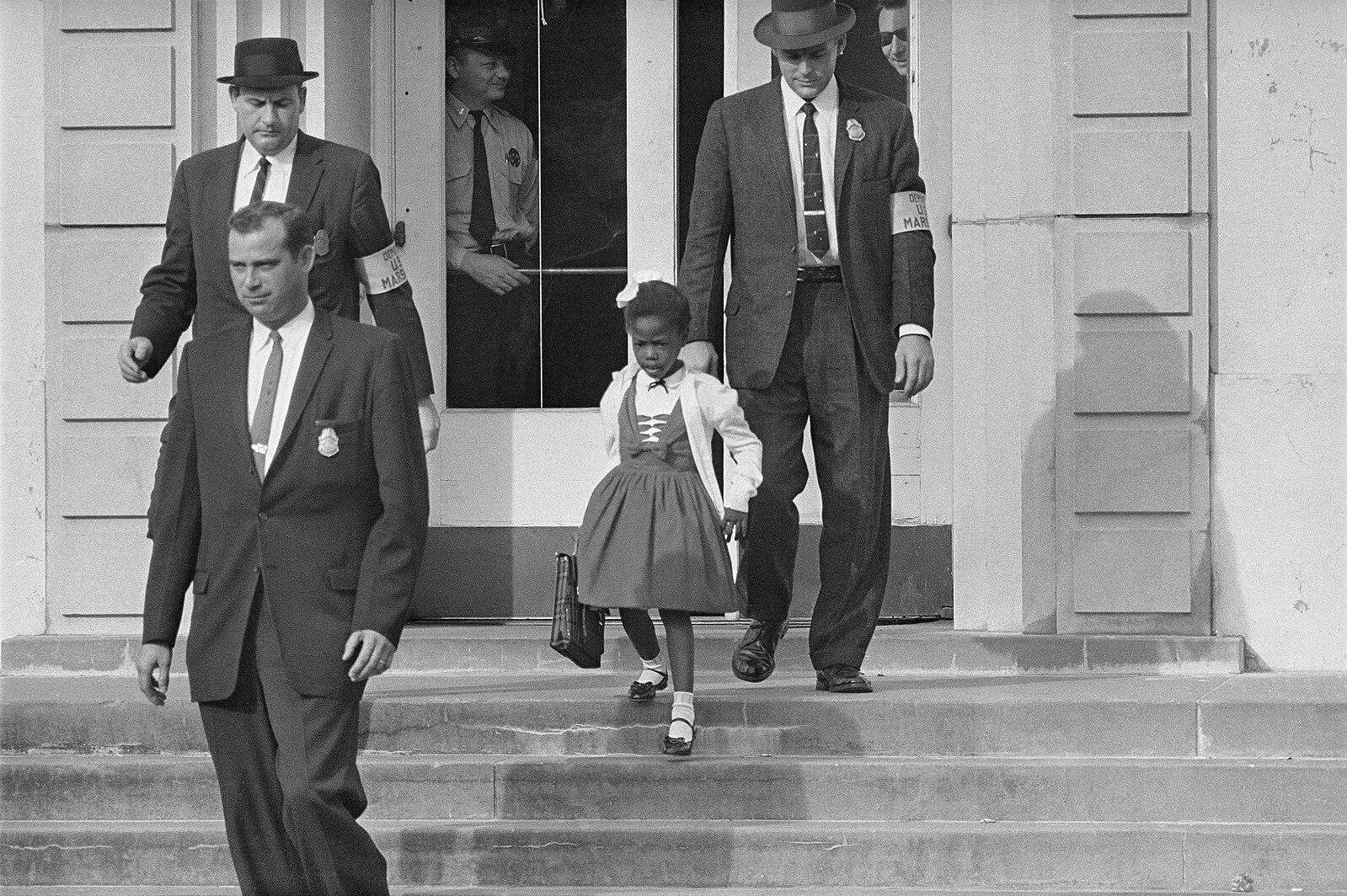
Ruby Bridges getting leaving school with security
Key Facts About Ruby Bridges for Students and Educators
Ruby Bridges was born in 1954, the same year the Supreme Court ruled in Brown v. Board of Education that segregation in public schools was unconstitutional.
She was one of six Black children selected to integrate New Orleans schools
Ruby attended William Frantz Elementary School as the only Black student for much of the year.
Four federal marshals escorted her daily for protection.
One teacher, Barbara Henry, taught Ruby alone when others refused.
Her walk to school inspired Norman Rockwell’s painting The Problem We All Live With.
In 1999, Ruby founded the Ruby Bridges Foundation, which promotes tolerance and understanding among children.
She is the author of Through My Eyes, where she recounts her experience in her own words.
Seeing Ruby Bridges in Real Time
Hearing Ruby Bridges speak as an adult adds weight to everything you think you know about her childhood. There is no bitterness in her voice, but there is clarity. She understands exactly what was taken, exactly what was gained, and exactly why her story still matters.
I’ll be sharing more reflections from that experience, along with photos and video, on my Substack. That space feels right for slowing down and sitting with what it means to be in the presence of someone whose childhood altered the course of American education.
Why Ruby Bridges Still Matters Today
Ruby Bridges is often taught as a lesson about the past. But seeing her reminds you that history is not distant. It ages. It speaks. It asks something of us.
She is not just a symbol of courage at six years old. She is a reminder of what sustained bravery looks like across a lifetime.
